Does thyroid function predict metabolic health? Tested against NHANES data
2026-08-29
In this project, I tested some claims derived from the thinkings and opinions of Ray Peat, a prominent researcher with a Ph.D. in biology from the University of Oregon, and some opinions from the Peat-sphere on X/Twitter. Peat's central claim is that energy and structure are interdependent at every level.
In the past few years, Ray Peat's ideologies have been pushed prominently on social media, becoming the topic of many widespread conversations from health and gym-bros alike. His takes on dieting have become widespread and the center of many debates.
Using NHANES data, I decided to take a look and see if some of the claims made online and by Peat himself hold up or fall short. One of Peat's central claims is that PUFA (polyunsaturated fatty acids), now common in the modern food supply through seed oils, suppresses thyroid conversion and drives inflammation. If most people's diets do skew toward high PUFA intake the way Peat's framework assumes, that raises a grand question. Either the thyroid axis behaves the way the framework predicts and the diet claim matters, or it doesn't and the diet claim is irrelevant, regardless of how common seed oils are. It is important to note that this analysis does not measure anyone's diet directly. NHANES has dietary recall data, but that's not what is being used here. Instead, I'm testing the claims at the level Peat's framework actually depends on. That means looking at circulating hormone levels and the metabolic markers they're supposed to predict.
The short version is that the hypotheses tested, mostly, didn't hold up. Three of four pre-registered hypotheses were not supported, and the one statistically significant result ran in the opposite direction from what the framework predicts.
The question
Peat's framework argues that efficient thyroid hormone conversion (T4 → T3) and adequate free T3 drive a more efficient, "pro-metabolic" physiology, protecting against high triglycerides, inflammation, and other markers of metabolic dysfunction. I turned that into four pre-registered hypotheses and tested each one against NHANES data (2007–2012, the three cycles with a full thyroid panel), using non-pregnant adults age 20+ with no thyroid disease or thyroid medication use (pooled n=3,459).
The methodology
Some choices in the analysis that I made:
- Design-based survey weights, strata, and PSUs — NHANES is not a simple random sample, so unweighted statistics would misrepresent the U.S. population. See the note prior for more details regarding NHANES data bias.
- Pooling across three survey cycles using the standard NHANES divide-by-number-of-cycles weighting approach, to get enough sample size for the less common outcomes (e.g. metabolic syndrome).
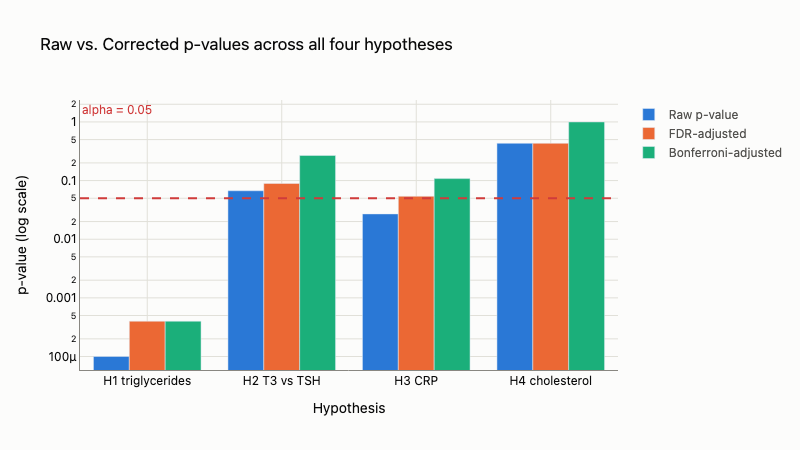
- FDR and Bonferroni correction across all four hypotheses' primary tests — evaluating four hypotheses at p < 0.05 without correction overstates the evidence.
What I found
| # | Hypothesis | Result |
|---|---|---|
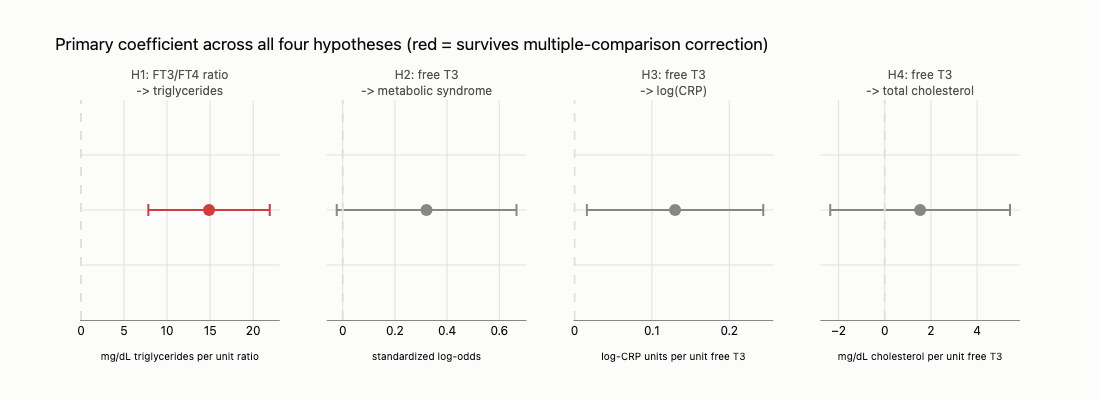
| H1 | Higher FT3/FT4 ratio -> lower triglycerides | Falsified — significant, opposite direction, survives correction |
| H2 | Free T3 outperforms TSH at predicting metabolic syndrome | Ambiguous — narrow edge on AUC/AIC, but TSH has the significant individual coefficient |
| H3 | Lower free T3 -> higher CRP (inflammation) | Not supported after correction |
| H4 | Higher free T3 -> lower total cholesterol | Null |
Only H1 survived correction for testing four hypotheses — and it's the one result that runs clearly counter to the framework: a higher free-T3/free-T4 ratio is associated with higher, not lower, triglycerides (+14.9 mg/dL per unit ratio, p < 0.001, robust to BMI adjustment).
My thoughts
During this process, I was treating Peat's and the Peat-sphere's claims as something that is testable. Using the NHANES sample, most of the hypotheses I tested did not hold up.
The result that survived the multiple-comparison correction, which reversed from my original hypothesis, is that a higher free-T3/free-T4 ratio is associated with higher triglycerides, not lower. After adjusting the original sample for BMI, the results did not have a significant change.
In other hypotheses, free T3 did not predict lower total cholesterol. As for free T3 versus TSH as a predictor of metabolic syndrome, this one came out mixed rather than a clean win either way. Free T3 had a slight edge in overall predictive power on AUC and AIC. TSH was the one whose individual coefficient actually reached significance though. So neither marker clearly beat the other. It really just depends on which angle you're looking at it from.
However, as noted at the beginning of this piece, the suggesting framework to take away from this is that circulating free T3 and the FT3/FT4 ratio are bad indicators for the Peat framework described as "pro-metabolic."
According to the Peat community on forums and social media like X, many advocates would point towards the fact that labs are targetting the wrong things. They would say that free T3, free T4, and TSH are weak tests for the pro-metabolic framework, arguing that factors like temperature, pulse, cholesterol, and prolactin are better markers. However, it is important to note that this is a potential issue with the markers, not the actual regressions. The NHANES data does not contain things like temperature and prolactin, but pulse and cholesterol are used, which is why I used them in the additional hypothesis.
So while the original hypotheses were against the Peat framework, that is not to say that the cause of these things are shown. Things like illnesses can suppress T3 production and obesity and a fatty liver can change the overall conversion and cause worsening lipids in the body. In this analysis I did not disprove bioenergetics, but the hypotheses that I tested mostly failed using national data.
In my opinion, I think that the conclusion that you should draw from this is that single free-T3 or the FT3/FT4 ratio values cannot be used as evidence regarding someone's metabolism and being "protected." An interesting question that now resides, is whether these functional markers, or a change after thyroid medication or diet intervention, can be differentiated and behave differently. Unfortunately, NHANES can only provide so much data.
Full analysis
The complete pipeline, notebooks, and writeup — including two more hypotheses not covered here — are on GitHub: Project Bioenergetics.